

Free, project-based training
A cyber security course for people who want to defend, not just describe.
Free at 42 Belgium, in Brussels and Antwerp. You analyse vulnerabilities, write exploits in lab environments, harden systems, and dissect real incidents — inside the broader software engineering curriculum. AWS prep available, RNCP 6 & 7 path open.
100% free · No degree required · Brussels & Antwerp · RNCP 6 & 7 path available
01 · CYBER SECURITY TRAINING
Cyber security training that mirrors how attacks actually work.
Cyber security training only matters when you can apply it under pressure. At 42 Belgium, the cyber security courses live inside the Phase 3 advanced curriculum, after the Common Core has built the foundations: C, systems, networking, databases. From there, you specialise. Our cybersecurity courses aren't lectures - they're project workflows where you test, harden, audit, and rebuild real systems. You face challenges that mirror the SOC, the red team room, and the incident response cycle. The cyber security part of your portfolio includes work that recruiters can actually evaluate, not just a list of topics covered. That's the difference between completing a course and being employable in the field.
Phase 3 specialisation, after the Common Core
Test, harden, audit, rebuild real systems
Modelled on the SOC and red team
A portfolio recruiters can actually evaluate
02 · ETHICAL HACKING
Ethical hacking: built into the cyber curriculum, not bolted on.
Ethical hacking isn't a separate ethical hacking course at 42 - it's woven into the cyber security specialisation. You learn to read code with adversarial intent: where would I attack this? What does the developer assume that I can break? You write exploits in lab environments, build CTF-style challenges, and reverse engineer binaries. Any hacking course worth its name forces you to defend something you've actually attacked, not just read about. That's the workflow here. By the time you graduate, you've earned the right to call yourself a hacker - in the original, technical sense of the word - because you've done the work. And because you've done it inside a curriculum that takes ethics as seriously as technique.


03 · CREDENTIALS & CERTIFICATIONS
Cyber security certifications: what 42 prepares you for.
42 Belgium doesn't issue its own cyber security certifications - but the curriculum is built to prepare you for the ones the industry already recognises. The cyber specialisation maps onto AWS security certification tracks and similar cloud and infrastructure exams, with the underlying knowledge built through hands-on projects. If you came here looking for a bachelor cyber security path, the RNCP framework offers exactly that: by passing the RNCP 6 examination, you earn a professional diploma recognised across Europe - the equivalent of a cybersecurity bachelor's degree. RNCP 7 extends to master-level. So the answer to 'where are the cyber security certifications?' is: they're after the work, certified by external bodies, and now within reach because you've earned them.
The outcome
98%
of advanced grads secure a job
Life after 42: 98% employment.
98% of students who complete the advanced curriculum secure a job. Many are recruited during internships or while still working on projects at 42. You graduate with a portfolio, a track record, and a global alumni network in every major tech city.
Graduation doesn't mean goodbye. Alumni are students for life - always welcome back to campus to exchange, mentor, or keep learning.
Our partners and sponsors












The program
What you'll actually build.
The 42 Belgium program is structured around real projects, not lectures. Four phases, one trajectory - from your first line of code to your career launch.
You learn to code from scratch, then build your way up through progressively harder projects. The Common Core gives every student a solid foundation - both hard and soft skills.
- Languages - C, Python, and others along the way
- Algorithms & data structures - the logic behind every codebase
- UNIX, file systems, processes - how software actually runs
- Network programming - the architecture behind modern apps
- Object-oriented programming - writing code that scales
- Client-server projects - building the backend of real systems
- Web programming - from HTML to full-stack deployment
- Graphics programming - rendering pixels, building interfaces
- Artificial intelligence - the fundamentals powering modern systems
- Concurrent programming - multi-threading and parallelism
After the Common Core, many students take a first internship or job in tech. Not mandatory, but strongly recommended. This phase often helps students confirm their interests and return to 42 with clearer goals.
- Apply your skills in real-world conditions
- Understand professional workflows, tools, and team dynamics
- Explore different career paths before specialising
Choose your specialisation and go deeper - up to a master-equivalent level.
How it works: Like in a video game, you can try, fail, and try again until you succeed. As you complete and validate projects, your level increases to reflect the skills you've mastered along the way. At each level, you discover new areas of coding and IT. This makes every student's journey unique, while still covering a shared foundation.
- Artificial Intelligence & Data
- Cybersecurity
- Web & Mobile development
- Operating systems
- Graphical programming
Flexibility:
- You are not obligated to stick to one specialisation or complete it fully.
- You can move between tracks, experiment with different fields, and choose projects that fit your goals.
- Each student is free to decide when to graduate and officially become a 42 Alumni.
Global mobility: This phase can be pursued not only in Brussels or Antwerp but also at any other 42 campus worldwide.
Many students secure job offers during this phase - often before they officially graduate. Industry certifications (AWS and others) add professional credibility.
- Put advanced skills into practice in longer, specialised roles
- Build deeper professional expertise and network
- Secure long-term opportunities - many receive offers here
Plus: industry certifications (AWS cloud and others), and a philosophy of sharing that shapes how you learn.
Real students
Real stories from real students.
Three alumni share what the 42 journey was like - in their own words.
Kevin
42 Stories · Piscine selection sprint
Morgane
42 Stories · Piscine selection sprint
Sam
42 Stories · Piscine selection sprint
Campus visits
Come meet us at an Open Day.
No pressure, no commitment. Walk the campus, meet the team, ask every question you have - in Brussels or Antwerp.

Brussels
Next to Central Station.
Canterssteen 12
A two-minute walk from the Central Station. Visit the campus, meet current students, see how peer-to-peer learning actually looks.
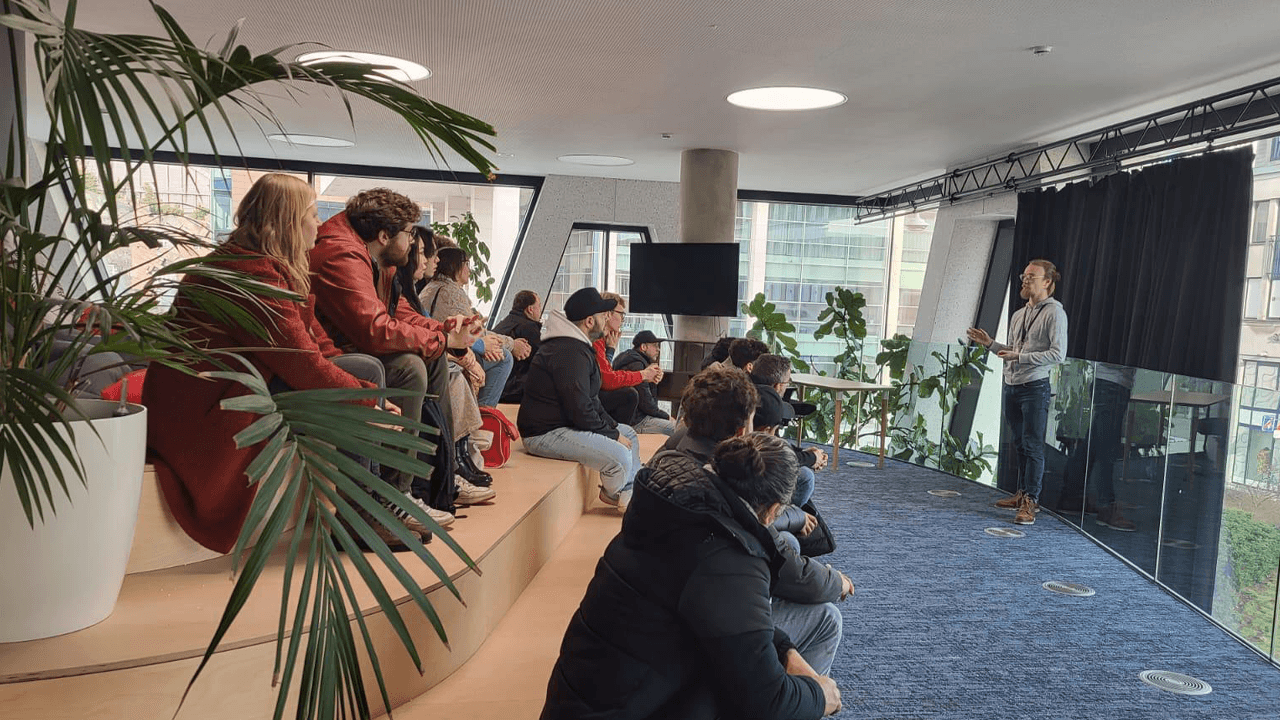
Antwerp
In the heart of the city.
Mediaplein 1
Our Antwerp campus sits in the thick of the city's creative and media district, in the DPG building. Come spend an afternoon with the team.
The path
How to join 42 Belgium.
Online logic test (~1 hour)
No coding needed, it's just logic. Choose a quiet spot, as you can't pause or restart. Stay focused and keep going - you've got this!
Meeting - on campus or online
Come visit our campus in Brussels or Antwerp and learn more about the program.
Some check-in sessions are also online, but don't forget to register!
Enter the Piscine
You'll be immersed for 4 weeks on our campus in Brussels or Antwerp. You'll get a taste of coding, our unique approach, and life at 42. Enough to really know if 42 is for you.
Start the Common Core
After passing the Piscine, you can officially start the Core Program.
You'll have 24/7 access to the campus, work on real projects, and discover a community full of fellow coders.
Next Piscine dates on campus - apply anytime.
FAQ
Questions
42 Belgium itself doesn't issue cyber-specific certifications - the diploma equivalence comes through the RNCP framework. Passing RNCP 6 gives you a professional diploma recognised across Europe at bachelor level; RNCP 7 reaches master level. Beyond that, the curriculum prepares you for industry exams like AWS security certification, and the practical work you've done becomes evidence in itself when you sit them.
None to enter 42, but the cyber specialisation sits in Phase 3 - after the Common Core. That means you'll have shipped C, systems, networking, and database projects before you specialise. Most students reach this stage 12 to 18 months in. If you're already an IT professional reconverting, you may move faster, but the curriculum doesn't skip foundations.
Yes - internships are a recommended part of Phase 2 and Phase 4. For cyber security students, that often means a SOC analyst, junior pentester, or security engineer placement with one of our partner companies. The internship isn't separate from the specialisation; it's where the work you've done on campus meets the conditions of a real security team.
What certifications can I actually walk away with?
42 Belgium itself doesn't issue cyber-specific certifications - the diploma equivalence comes through the RNCP framework. Passing RNCP 6 gives you a professional diploma recognised across Europe at bachelor level; RNCP 7 reaches master level. Beyond that, the curriculum prepares you for industry exams like AWS security certification, and the practical work you've done becomes evidence in itself when you sit them.
Question 01 of 03
98%
of advanced grads secure a job
100%
Free - no tuition
42
Campuses worldwide
0
Prerequisites

The cyber security course that earns its keep.
Phase 3 specialisation, AWS prep, RNCP 6 & 7 pathway. All free, no tuition, no degree required. Apply year-round.